Selected work
One line I keep coming back to: a small set of hyper-polluting power plants — roughly 5% of them produces about 73% of the electricity sector's emissions, a co-authored finding. Engagements span academic research, government, NGOs, and enterprise. Each project blends multiple capabilities, often across different domains. Below: three representative engagements, then the tools and systems I've built.
Browse by domain
Case studies
Work with the sources attached
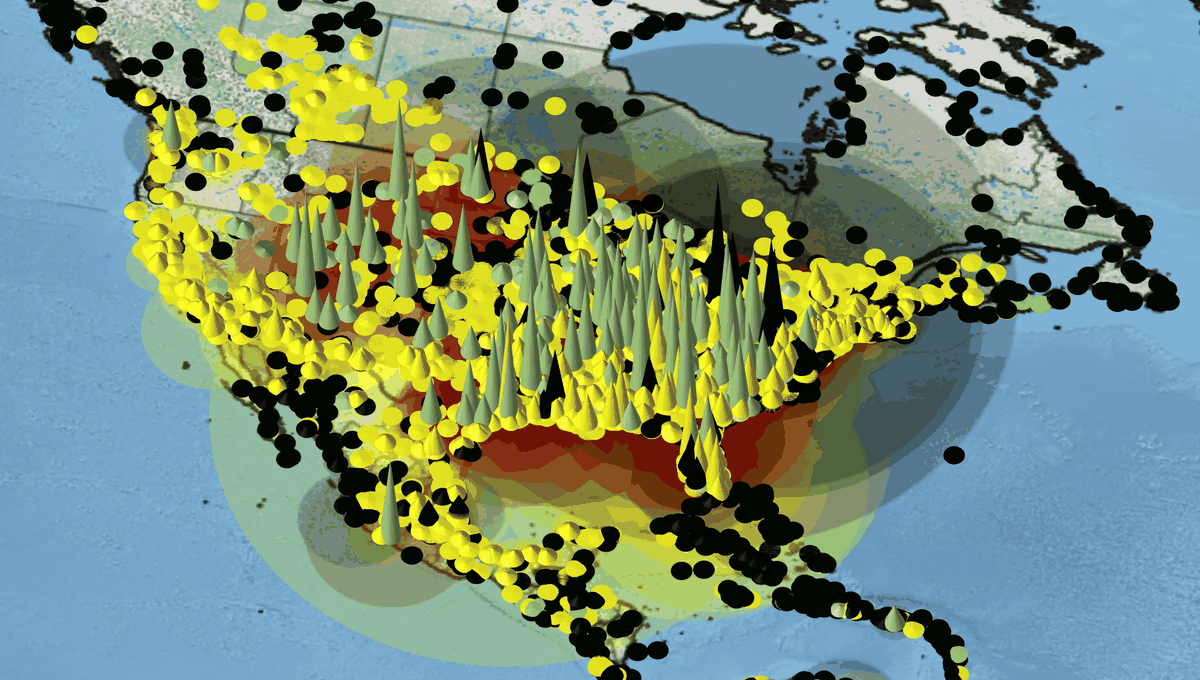
Targeting hyper-polluting power plants
RASEI, CU Boulder (NSF-funded) · 2019–2021
A global analysis of how climate and energy policies actually affect emissions from the world's electricity sector. I led the climate side of the work: integrated 16 distinct power-plant and policy databases via custom ETL, geocoded missing facility locations across more than 30,000 plants, used gradient-boosting ML to fill remaining gaps with 99.9% accuracy, and performed spatial joins to map each plant to the policies governing it. The headline finding: a relatively small set of hyper-polluting plants drives a disproportionate share of global emissions, suggesting that geographically targeted policy could yield outsized climate benefits. Published in Environmental Research Letters (Grant, Zelinka & Mitova, 2021).
Climate & GHGData & toolingNetwork analysis of political corruption in Bosnia
United States Institute of Peace · Transparency International · 2021–2025
A graph-data-science project mapping the structural relationships between political parties, state-owned enterprises, and corporate actors in Bosnia and Herzegovina. I built a custom data pipeline in Python (NetworkX, SciKit-Network) to clean, link, and analyze records on shared directors, financial flows, and political appointments. Applied centrality measures — betweenness, PageRank, degree — to surface the hubs of influence within the political-economic network. Findings co-authored into a report presented to the European Council on Foreign Relations and used by in-country anti-corruption partners.
Peace EngineeringSystems science Read the full case Related service: network snapshotSystems thinking for Burkina Faso judicial reform
United States Institute of Peace · 2019–2021
Multi-year engagement supporting the design and implementation of systems-thinking training for Burkinabé judicial reform. I co-designed training content with in-country partners, facilitated six working sessions with judges, prosecutors, defense attorneys, and civil-society representatives, then synthesized the resulting qualitative data using grounded theory and causal-loop diagramming to identify performance and trust bottlenecks in the judicial system. The work shaped strategic plans for systemic improvements and was featured in a USIP publication on systems thinking for the Sahel.
Peace & developmentSystems science Read the full case Related service: systems & governance advisoryThe venture side of the practice — Connectome, with Soma and Axon in private beta — lives under Systems.
How I work
Common questions
You're just one person. We need a team.
Yes — and that's the design. Every engagement is senior-led, with no junior staffing layer you'd never see. When work needs additional hands, I bring in named collaborators and you meet them. If your project genuinely requires a team of ten, I'm probably not the right fit, and I'll say so before the contract.
What if you get sick or hit by a bus?
Every engagement includes documentation written for someone else to pick up — that's a design principle, not a contingency. I also keep a short list of named collaborators I'd refer clients to if continuity becomes necessary. And the practice is small by intent — I don't take on more than I can deliver well, so any single engagement is recoverable.
What does this actually cost?
The productized offers are fixed-scope, fixed-price, and the ranges are published on the Services page — most run $6K to $40K over one to four weeks, and the larger drafted offers — custom dataset builds and program evaluations — range from $18K up to $250K depending on scale. Defined projects and fractional advisory relationships are scoped per engagement — I'll quote a specific number once I see what you're working with. Multi-year academic collaborations often run at standard university research rates. Send a note describing what you need and I'll write a proposal with a real number.
Academic methods are too slow for our timelines.
Sometimes true. The methodology Civitas uses is the same standard as peer-reviewed publication — but the deliverable timeline is consulting-paced, weeks to months. The publication cycle is what's slow; the methodology itself doesn't have to be.
We need answers, not academic hedging.
Fair concern. A typical deliverable includes the headline finding stated as a probability or range, the methodology, the assumptions, the sensitivity analysis, and an explicit "what to do if you act on this and want to update later" section. The version of "we need answers" that's really "we need confidence theater" is what I won't deliver. False precision isn't on offer.
Your mission filter feels political.
It can read that way. The filter is mission-coherent rather than partisan: the work is about climate, peace, governance, and development, and the excluded sectors (fossil-fuel extraction, weapons, surveillance) are the ones most directly counterposed to that mission. If the filter feels political to your organization, the practice is probably not the right fit.
How do I actually start working with you?
Send a note describing the problem. I'll reply within a week. If it sounds like a fit, we talk for 20–30 minutes. If we both want to proceed, I write a one-page proposal with scope, timeline, and price. If not, I'll usually suggest where else to look.
Do we need to sign an NDA before we talk?
Usually no for an initial conversation — I treat any client conversation as confidential by default. For deeper scoping involving you sharing data or proprietary methodology, yes, a mutual NDA is reasonable. I have a template; yours works too.
Why should we trust you?
You shouldn't, yet. Trust gets built by the methodology being defensible, by the code running, by the documentation being clear, and by the first engagement being deliverable. A reasonable starting point is a small engagement (≤$25K) to test fit; if that works, the next one is larger. That's how most Civitas client relationships have started.
Are you using AI to do this work?
Yes, in specific ways. I use LLMs for parts of the work: drafting initial code, summarizing literature, classifying documents at scale. I do not use AI to write the methodology, the findings, or the analysis. Model output is always reviewed and validated against domain knowledge before it becomes part of a deliverable. Where AI assistance materially shapes a finding, the methodology section says so.