Case study
Systems Thinking for Burkina Faso Judicial Reform
United States Institute of Peace · 2019–2021
A multi-year engagement bringing systems-thinking methods to Burkinabé judicial reform — designed with in-country partners, not delivered at them.
Context
The problem
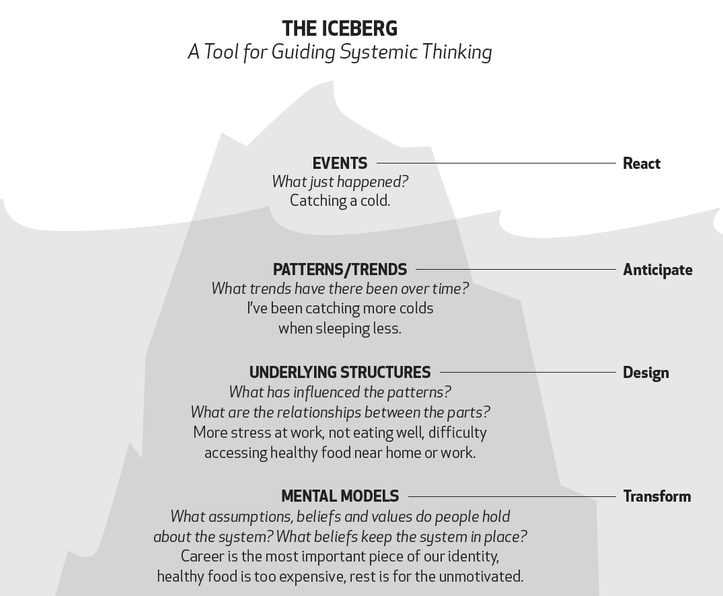
Judicial reform efforts tend to respond to events — a backlog, a failed prosecution, a public-trust crisis — with fixes aimed at the event itself. But events are the visible tip of a system: beneath them sit recurring patterns, the structures that produce those patterns, and the mental models that hold the structures in place. In Burkina Faso, the United States Institute of Peace wanted judicial reform work grounded at those deeper levels, and needed training and analysis that the justice system's own actors would recognize as theirs.
Approach
The method
I co-designed the training content with in-country partners rather than importing a fixed curriculum — the assumption being that a reform framework survives only if the people inside the system helped build it. I then facilitated six working sessions with judges, prosecutors, defense attorneys, and civil-society representatives.
The sessions produced a body of qualitative data, which I synthesized using two complementary methods: grounded theory, which lets categories emerge from what participants actually said rather than from a prior framework, and causal-loop diagramming, which maps the feedback structures participants described. Together they identified the performance and trust bottlenecks in the judicial system — where cases slow down, and where confidence between actors breaks.
Walk the method
How a causal loop reads
Causal-loop diagramming is the second of the two synthesis methods above. Rather than list problems, it traces how they feed each other: each arrow carries a sign — (+) means the two move together, (−) means one goes up as the other goes down — and closed chains of arrows form feedback loops. A loop that amplifies is reinforcing (R); one that self-corrects is balancing (B). The stepped figure below builds one small four-part structure link by link. Use Next and Previous (or the arrow keys once focused) to reveal each link with a short note.
Stepped causal-loop diagram · keyboard-operable
Start
Four variables, no links yet. Press Next to trace how a backlog feeds delay, delay erodes trust, and trust and pressure both bear on reform investment.
Illustrative of the systems-thinking approach used, not a published model. The four-variable figure is a teaching sketch; the loops the sessions actually produced trace to specific participant statements and stay confidential.
Text description of the causal-loop diagram
Four variables are connected by four signed causal links, forming two feedback loops.
- Case backlog increases court delay (same direction, +): a larger backlog means longer time to resolution.
- Court delay decreases public trust in the courts (opposite direction, −): the longer cases take, the less the public trusts the system.
- Public trust increases reform investment (same direction, +): when trust is present, political will and funding for reform hold up; when it falls, they fall with it.
- Reform investment decreases case backlog (opposite direction, −): investment in the system clears cases.
- Links 1 through 4 close a reinforcing loop (R) — with two negative links, it amplifies in whichever direction it starts: falling trust starves reform, backlog grows, delay worsens, trust falls further.
- A fifth link makes case backlog increase reform investment (same direction, +): a visibly growing backlog itself creates pressure to invest. Together with "reform investment decreases backlog", this forms a balancing loop (B) that pushes the backlog back toward a manageable level.
Whether the reinforcing or the balancing loop dominates is exactly the kind of question a facilitated causal-loop session is built to surface.
The result
The synthesis shaped strategic plans for systemic improvements to the judicial system, and the work was featured in a USIP publication on systems thinking for the Sahel. I would characterize the outcome honestly: training and analysis change how a reform effort sees its own system; whether that translates into durable institutional change depends on years of in-country work that belongs to the Burkinabé actors themselves.
Provenance
What traces to what:
- Data. Qualitative records from six working sessions with judges, prosecutors, defense attorneys, and civil-society representatives. Raw session data stays confidential — participants spoke about their own institutions.
- Method. Grounded-theory coding plus causal-loop diagramming; each loop in the diagrams traces back to statements made in the sessions.
- Publication. Featured in a USIP publication on systems thinking for the Sahel.