The seventeen Sustainable Development Goals are usually met as a poster: seventeen colored tiles, one per goal, each with its own targets and its own indicators. The poster is useful, but it hides the most important fact about the goals, which is that none of them stands alone. Food security depends in part on water and energy, health on poverty and education, and climate action pushes on nearly everything else. In two papers Bernard Amadei and I published in 2019, we treated that web of interactions – the SDG nexus – as the object of study itself, and asked what it would take to model the goals as one coupled system rather than seventeen separate projects.
Part 1 · Structure
First, the structure: the nexus as a network
The first paper takes a structural cut. Cross-impact analysis is a soft-systems method in which experts score how strongly each part of a system influences each other part, so that the scores assemble into a matrix and the matrix can be read as a network. Part 1 applies that method to the goals: each SDG becomes a node, each scored influence becomes a weighted link, and the interactions among the goals become something you can analyze with network tools rather than hold as a set of intuitions. The caveat comes built in, and the method is honest about it: the scores are judgments. Cross-impact analysis does not measure the world directly; it makes expert belief explicit, consistent, and inspectable, which I consider its main virtue rather than a defect.
A network like that is also a snapshot. It can show where influence concentrates, but it holds still while the real system moves, and the goals move on every timescale that matters. That limit is what the second paper is for.
Part 2 · Motion
Then, the motion: the nexus in system dynamics
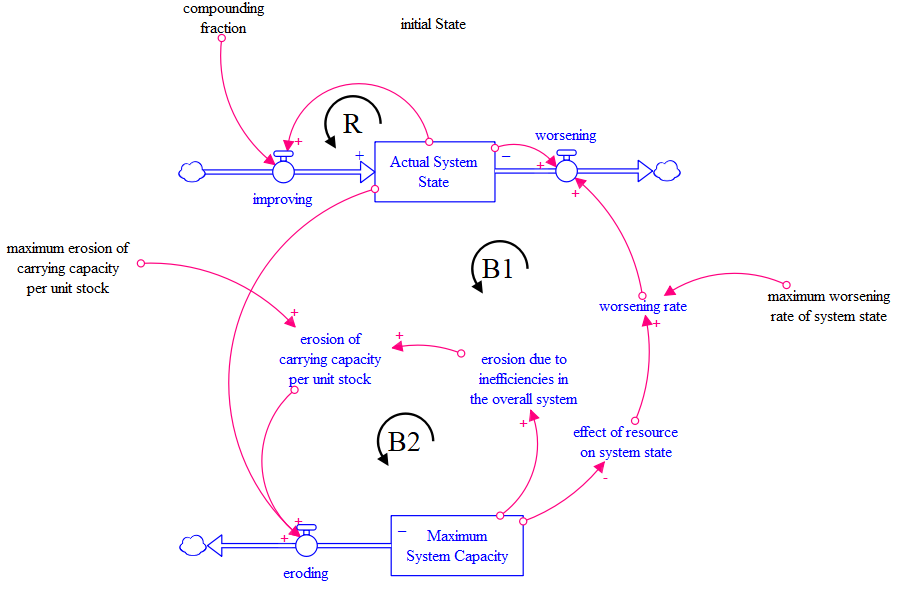
The second paper puts the same system in motion. System dynamics is Forrester's modeling tradition: stocks, flows, and feedback loops simulated through time, producing behavior-over-time charts that are best read as ranges and confidence intervals rather than single answers. Part 2 builds a system dynamics model of the SDG nexus in that tradition, with each goal modeled as a system moving from an insecure state toward a more secure one – an archetype we had introduced at the System Dynamics Society conference the year before – and the goals coupled so that change in one propagates, with delays, into the others.
The point of a model like this is not prediction. I would not trust a point forecast from seventeen coupled subsystems, and system dynamics does not ask me to; what the method surfaces is behavior – which feedback loops dominate, where delays hide, and which interventions come back around to feed or undercut themselves.
The point of a model like this is not prediction. It is behavior.
The framing
What the framing buys
Calling the nexus a complex coupled system is not decoration; it changes what counts as an answer. A complex system cannot be fully comprehended, because there are too many parts interacting and doing too many things, and seventeen interacting global goals qualify if anything does. Complex problems therefore do not have right answers in the way complicated problems do: there is no single right answer to optimize toward, so the useful move is to make the trade-offs explicit and treat outcomes the way the chapter does — as ranges of possibilities and average states. That framing is developed in the chapter Bassel Daher and I wrote in 2021, which takes the SDG nexus as its motivating case and describes it as seventeen insecure→secure subsystems coupled through an interlinkages hub. The chapter is also explicit that placing the nexus within its classification framework rests on expert judgment rather than direct measurement, and I want that uncertainty visible here too.
The assumptions deserve naming. The cross-impact scores are expert judgments; the model simplifies each goal drastically; and coupling seventeen of anything guarantees that some of the model's behavior is an artifact of the choices inside it. I think the approach earns its keep anyway, because the alternative – seventeen separate plans, each optimized alone – quietly assumes the interactions are zero, and that is the one assumption I am confident is wrong.
Go deeper
The system dynamics model of SDG interactions is public on the isee Exchange. The classification framework the 2021 chapter builds around this case has its own interactive explorer and a companion draft essay.
References
Citations
Zelinka, D., & Amadei, B. (2019). A Systems Approach for Modeling Interactions Among the Sustainable Development Goals — Part 1: Cross-Impact Network Analysis. International Journal of System Dynamics Applications, 8(1), 23–40.
Zelinka, D., & Amadei, B. (2019). A Systems Approach for Modeling Interactions Among the Sustainable Development Goals — Part 2: System Dynamics. International Journal of System Dynamics Applications, 8(1), 41–59.
Zelinka, D., & Amadei, B. (2018). A new insecure–secure diffusion archetype to model complex anthropocentric systems. 36th International Conference of the System Dynamics Society.
Zelinka, D., & Daher, B. (2021). Modeling the Sustainable Development Nexus as a Complex-Coupled System: System Dynamics Modeling. In Handbook of Research on Modeling, Analysis, and Control of Complex Systems (ch. 2). IGI Global. doi:10.4018/978-1-7998-5788-4.ch002